

Recently, someone asked me about the state of “health and safety in OSHA” and my answer surprised even me. I responded by saying, “I do not feel like they are doing enough.” This does not mean that OSHA is not a vital entity in supporting safety and health. OSHA has had a big impact on the safety and health of workers since its inception. After working in ES&H for over 25 years, I feel like there is so much more they could do. Let’s look at the data.
Exhibit #1: The Top 10 Most Frequently Cited Standards. Annually, OSHA publishes a list of commonly cited standards to encourage employers to note where problems typically appear when implementing OSHA requirements. Since 2004, the top ten have included the following standards: Fall Protection (1926.501), Hazard Communication (1910.1200), Scaffolding (1926.451), Respiratory Protection (1910.134), Lockout/Tagout (1910.147), Powered Industrial Trucks (1910.178), Ladders (1926.1053), Electrical Wiring Methods (1910.305), Machine Guarding (1910.212) and Electrical – General Requirements (1910.303). The last change ( ) to the list was in 2004 when Mechanical Power Transmission Apparatus (1910.219) dropped off the list and Ladders were added.
Exhibit #2: Fatality rates. Annually, the Bureau of Labor Statistics (BLS) publishes the worker injury, illness and fatality data. Prior to the BLS releasing this data, the National Safety Council reported that in 1970 the number of workers who died while working was 13,800. In 2015, the number of workplace fatalities was 4,836. This is a decrease of 65%! How have the number of fatalities decreased over the last 10 years? Overall, the trend shows a decrease. When using one standard deviation to define the upper and lower control limits, it is generally not statistically significant as shown in the table below. In the last ten years, the number of workplace fatalities has dropped 17%. In the last seven years, it has increased 6%.
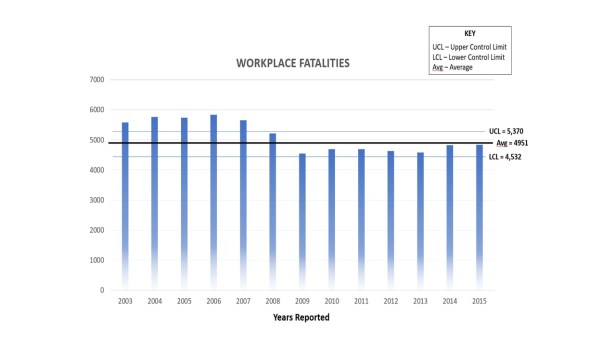
There is no doubt of the significant changes that have occurred as a result of OSHA. However, the recent data does not demonstrate much change in the challenges to worker safety and health. This may be changing as a result of reporting requirements that went into effect in January 2015. Now, OSHA requires employers to report severe injuries within 24 hours and fatalities within 8 hours (which is not new). It seems as if the reporting is a trigger to do a more in-depth analysis of severe events and fatalities which allows for causal factors to be analyzed. An evaluation of the program during the first year is available at: https://www.osha.gov/injuryreport/2015.pdf.
If we want to have a huge impact on reducing injuries, illnesses and fatalities in the workplace, we need to evaluate causal factors. This involves documenting events and trending data other than what OSHA requires before severe events and fatalities occur. For example, the top ten most frequently cited standards is a great way to determine where most citations occur. Here are the types of questions that should be asked: Why are employers failing to implement these standards? Is it resources? Is it knowledge? Are the workers properly trained? Are managers working with employees? Do workers know how to recognize hazards? We have the technology to analyze the data, but it appears , we are not collecting the right data.
What is the right data? We can work backwards to answer that question. When an incident occurs, it is because a control failed. Controls vary from being engineering (i.e. interlocks), work practices (i.e. training or procedures) or personal protective equipment (i.e. hard hats or safety glasses). We should be asking the question, “What caused the control to fail?” Currently, we spend a lot of time counting the number of injuries. We should be focused on why the control failure caused the injury. This seems to be the direction that OSHA is moving towards as well.
Optimally, causal factors should be identified BEFORE work begins. That is a subject for another blog.
 De Oliveira Enterprises, LLC